
India has not abolished the death penalty, but the Supreme Court permits it only in the “rarest of rare” cases, after a genuine inquiry into both the crime and the offender. This article examines the constitutional framework, the leading judgments and the Law Commission’s 262nd Report.
By APK Socii Legales · Download this article (PDF)
Introduction
The death penalty is the State’s most irreversible exercise of penal power. Unlike imprisonment, execution ends any possibility of correcting a wrongful conviction, reconsidering a sentence in the light of new evidence, or allowing a person to demonstrate rehabilitation. At the same time, the State has a duty to protect the public, recognise the suffering of victims, and respond proportionately to the most serious crimes.
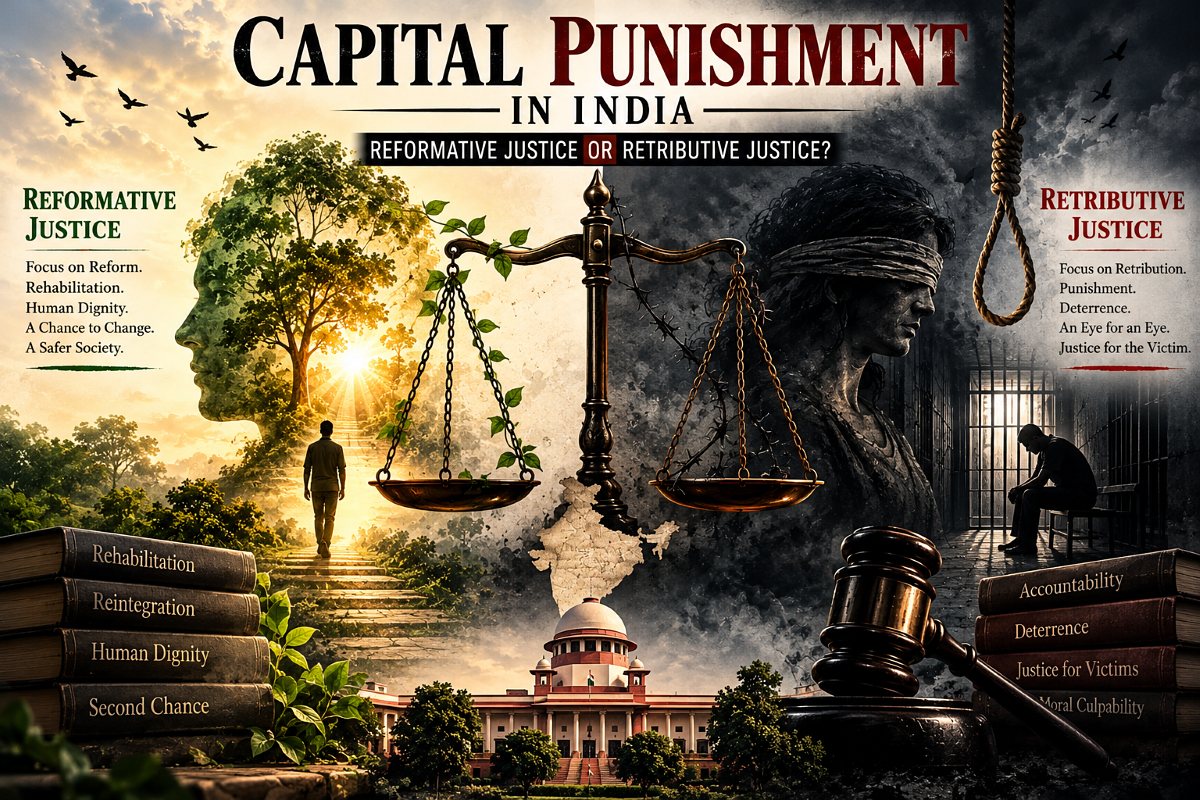
The debate is often framed as a choice between retribution and reformation. Retributive justice asks whether a punishment is deserved in proportion to the wrong done. Reformative justice asks whether the offender can change and return to society, and whether punishment should help that change. Modern sentencing law also recognises deterrence, incapacitation, denunciation and restorative considerations. The real legal question is therefore not whether one theory should displace all others, but whether execution can be justified after a fair, individualised assessment of every relevant circumstance.
In India, the broad constitutional position is settled: the death penalty is not unconstitutional in itself, but it may be imposed only within strict judicial limits. The “rarest of rare” standard requires courts to ask whether life imprisonment is genuinely inadequate and whether the possibility of reformation has been properly considered. This article argues that, under current law, death is legally available but must remain an exceptional and carefully reasoned punishment. A reformative approach is not an automatic bar to capital punishment, but it is a central constitutional consideration.
The constitutional and statutory framework
Article 21: life, liberty and fair procedure
Article 21 of the Constitution provides that no person shall be deprived of life or personal liberty except according to procedure established by law. The Supreme Court has read this to require a procedure that is fair, just, reasonable and non-arbitrary. In capital cases, the gravity of the consequence demands especially careful procedure, meaningful legal representation and a reasoned sentencing decision.
In Bachan Singh v. State of Punjab, (1980) 2 SCC 684, a Constitution Bench upheld the constitutional validity of the death penalty for murder but confined it to the “rarest of rare” cases. The majority held that death may be imposed only when the alternative of life imprisonment is “unquestionably foreclosed”, and required attention both to aggravating circumstances relating to the crime and to mitigating circumstances relating to the accused.
The statutory position
The Bharatiya Nyaya Sanhita, 2023 (BNS), in force from 1 July 2024, retains death as a possible punishment for specified offences, including murder under Section 103 and certain other grave offences. Which provision applies depends on the offence and the date of the alleged conduct, and transitional questions may require examination of the earlier law. The Bharatiya Nagarik Suraksha Sanhita, 2023 (BNSS) now governs criminal procedure, while the Code of Criminal Procedure, 1973 (CrPC) remains relevant to proceedings saved by the transitional provisions.
Section 393(3) of the BNSS, which corresponds to Section 354(3) of the CrPC, requires a court to record special reasons when it imposes death rather than the alternative sentence for an offence punishable with death or life imprisonment. A death sentence passed by a Sessions Court must also be confirmed by the High Court. Confirmation is a substantive safeguard, not a formality.
Equality and non-arbitrariness
Article 14 matters because sentencing discretion must not become arbitrary or discriminatory. In Mithu v. State of Punjab, (1983) 2 SCC 277, the Supreme Court struck down Section 303 of the Indian Penal Code, which made death mandatory for a life convict who committed murder, as violating Articles 14 and 21. The provision removed judicial discretion and prevented an individualised assessment. Mithu shows that, even for grave crimes, a mandatory death sentence cannot survive constitutional scrutiny.
Retributive and reformative justice
The retributive case for capital punishment
The retributive argument holds that punishment should reflect the seriousness of the wrong. Its supporters contend that, for exceptionally brutal murders or crimes causing extraordinary harm, the most severe punishment expresses society’s condemnation and recognises the gravity of the victim’s loss. Some add that execution permanently incapacitates the offender.
These arguments carry moral and political force, particularly in cases of extreme violence. Yet retribution in a constitutional democracy is not vengeance. Punishment must remain lawful, proportionate, based on reliable proof and imposed through a fair process. Public outrage, or the shocking nature of an offence, cannot by itself replace the judicial test.
The reformative case against execution
The reformative approach treats the offender as a person capable, at least in some cases, of change. It asks courts to consider age, background, mental and emotional condition, previous record, conduct in prison, role in the offence, the influence of others and evidence of rehabilitation. Execution permanently forecloses reform, and makes correction impossible if the conviction or sentence later proves wrong.
Reformation does not mean excusing the offence or ignoring victims. It means that sentencing must assess the individual rather than treat the crime alone as decisive. Life imprisonment, including a fixed-term or whole-life sentence where the law permits, can protect society while avoiding the finality of execution.
A constitutional synthesis
Indian law does not adopt an absolute reformative theory. It permits death in a narrow category of cases, while requiring courts to test the possibility of reform. In practice, the prosecution must establish not only the exceptional gravity of the crime but also why life imprisonment is inadequate and why rehabilitation is not a realistic possibility. Because death is irreversible, the burden of a reasoned explanation is particularly heavy.
Leading Supreme Court judgments
Bachan Singh v. State of Punjab (1980)
Bachan Singh is the foundational authority. The Constitution Bench upheld the death penalty but rejected its routine use: life imprisonment is the rule and death the exception, to be imposed only in the rarest of rare cases, when the alternative is unquestionably foreclosed. Courts must weigh the circumstances of both the crime and the criminal, including the possibility of reformation. The case establishes that brutality alone is not a complete sentencing analysis; a court must explain why the case crosses the exceptional threshold and why life imprisonment will not suffice.
Machhi Singh v. State of Punjab (1983)
Machhi Singh, (1983) 3 SCC 470, elaborated the rarest-of-rare framework and described categories of aggravating circumstances: the manner of commission, the motive, the magnitude of the crime and the personality of the victim. These categories aid structured reasoning; they are not a mechanical checklist. Read with Bachan Singh and later decisions, Machhi Singh cannot be used to bypass the separate inquiry into the offender’s circumstances and the feasibility of reform.
Santosh Kumar Satishbhushan Bariyar v. State of Maharashtra (2009)
Bariyar, (2009) 6 SCC 498, warned against treating the rarest-of-rare doctrine as a formula. The sentencing inquiry must consider the criminal as well as the crime, and the possibility of reform cannot be dismissed on assumptions. A conclusion that an offender cannot be reformed needs a sound evidentiary foundation.
Sangeet v. State of Haryana (2013) and Shankar Kisanrao Khade v. State of Maharashtra (2013)
Sangeet, (2013) 2 SCC 452, highlighted inconsistencies in how aggravating and mitigating circumstances had been applied and cautioned against an unstructured balancing exercise. Shankar Kisanrao Khade, (2013) 5 SCC 546, examined the difficulty of applying the death penalty consistently. Together they support a disciplined, transparent sentencing method in place of an impressionistic judgment driven by the horror of the crime: a death sentence must not be imposed merely because a crime is shocking.
Shatrughan Chauhan v. Union of India (2014)
In Shatrughan Chauhan, (2014) 3 SCC 1, the Court considered circumstances arising after mercy petitions are rejected. It recognised that undue delay, mental illness and other supervening circumstances may make an execution unconstitutional in an appropriate case. The decision confirms that constitutional protections continue after conviction, and that prisoners on death row retain enforceable rights.
Manoj v. State of Madhya Pradesh (2022)
In Manoj, 2022 SCC OnLine SC 677; (2023) 2 SCC 353, the Supreme Court commuted the death sentences of three accused. It criticised an inadequate sentencing process and held that courts need meaningful information about the accused, including social history, mental health, prison conduct and prospects of rehabilitation. The State cannot expect a court to conclude that reform is impossible without placing relevant material on record.
The practical lesson is that mitigation must be investigated and presented, not left to speculation. The sentencing hearing is a substantive stage of the trial, and defence counsel must have a real opportunity to develop material relevant to punishment.
The mitigation inquiry since Manoj
The Supreme Court has continued to refine when and how mitigating material is gathered. In September 2022, in In Re: Framing Guidelines Regarding Potential Mitigating Circumstances to be Considered While Imposing Death Sentences, a three-judge bench referred to a Constitution Bench the question of when an accused facing a possible death sentence must be heard on mitigating circumstances, noting conflicting decisions on the point.
In Sundar @ Sundarrajan v. State by Inspector of Police (21 March 2023), the Court reopened a death sentence on review, applied Bachan Singh and commuted the sentence, directing that the petitioner serve at least twenty years without remission, because the possibility of reformation had not been ruled out.
Most recently, in Aman Singh v. State of Bihar (27 April 2026), the Court flagged systemic gaps in death-penalty sentencing and set out a framework for mitigation reports and legal aid. As modified on 7 October 2026, it requires High Courts to call for comprehensive, verified mitigation and aggravation reports when admitting a death reference, if none were placed before the trial court. Legal services authorities must provide dedicated teams of experienced counsel for confirmation proceedings, and the National Legal Services Authority is to frame guidelines for mitigation investigation. A wider direction requiring trial courts to call for such reports in every death-eligible case was deleted.
The role of the High Courts
High Courts play a critical role because a Sessions Court death sentence requires their confirmation. The High Court must independently examine the evidence, the conviction and the sentence; it cannot merely endorse the trial court’s conclusion. Its analysis should address the statutory requirements, the aggravating circumstances, the mitigating material, the availability of life imprisonment and the reasons why the case meets the rarest-of-rare standard. Since 2026, it must also ensure that a mitigation report is on record.
High Court death-reference judgments routinely apply Bachan Singh, Machhi Singh, Bariyar and later authorities. The Supreme Court has repeatedly set aside or commuted death sentences where courts failed to assess mitigating circumstances or did not establish why life imprisonment was inadequate. Outcomes turn on the evidence and the quality of the sentencing analysis in each case. A sound confirmation judgment should address, at a minimum:
- the role and degree of participation of each accused;
- age and personal history;
- prior criminal record;
- mental and psychological condition;
- prison conduct and indicators of rehabilitation;
- the possibility of reform; and
- whether life imprisonment, including an appropriately structured sentence where lawful, would meet the ends of justice.
A heinous crime may be an aggravating circumstance, but it does not by itself prove that the offender is incapable of reform. Courts must not equate public revulsion with the constitutional test; the decision must remain individualised, evidence-based and reasoned.
Mitigation and sentencing procedure
Mitigating evidence is central to capital sentencing. It may include the accused’s childhood and family circumstances, poverty or deprivation, education, trauma, substance dependence, intellectual or psychosocial disability, mental illness, age, prior record, role in the offence, coercion or undue influence, prison behaviour, remorse and evidence of rehabilitation. These factors do not automatically reduce a sentence; they help the court assess culpability and future risk on an informed basis.
The State should not rely on the gravity of the offence alone to show that reformation is impossible. Courts should call for appropriate reports, give defence counsel adequate time and consider expert material where relevant. A rushed or perfunctory hearing undermines the reliability of the most consequential sentencing decision a court can make.
The absence of material on rehabilitation is not the same as proof that rehabilitation cannot occur.
Deterrence, wrongful conviction and unequal application
Deterrence
Deterrence is often invoked in defence of capital punishment. But the claim depends on reliable empirical evidence, and it cannot be assumed merely because death is the harshest punishment. The Law Commission’s 262nd Report examined the debate and found the empirical basis for deterrence uncertain.
Irreversibility and error
Criminal adjudication is not immune from error. Misidentification by witnesses, unreliable confessions, investigative failures, inadequate representation and later-discovered evidence can all undermine a conviction. A prison sentence can sometimes be corrected on appeal or review; an execution cannot be undone. Irreversibility gives special force to procedural safeguards and to caution in sentencing.
Disparity and consistency
If similar cases produce different outcomes without clear reasons, public confidence and equality before the law suffer. The concerns expressed in Sangeet and related cases show why a transparent sentencing framework is needed. Consistency does not mean identical outcomes in every case; it means that relevant differences are identified and explained.
Mercy powers, delay and death row
Articles 72 and 161 of the Constitution confer the power of clemency on the President and the Governors respectively. These powers operate alongside judicial remedies and are no substitute for a lawful sentencing process. In Shatrughan Chauhan, the Supreme Court held that supervening circumstances, such as inordinate delay in deciding mercy petitions and certain mental-health conditions, can be constitutionally relevant. A death sentence does not extinguish a prisoner’s rights under Article 21.
Clemency is sometimes cited as a safeguard against error. Yet executive mercy is not a complete answer to concerns about arbitrariness or irreversibility. The judicial process must itself meet constitutional standards, and the executive process must be fair and attentive to relevant circumstances.
The Law Commission’s 262nd Report (2015)
The Law Commission of India’s 262nd Report, The Death Penalty (August 2015), revisited the question in the light of constitutional values, human dignity, arbitrariness and the limited empirical basis for deterrence. It recommended abolishing the death penalty for all crimes other than terrorism-related offences and waging war against the State, and expressed the hope that complete abolition would follow. This was a recommendation, not a binding rule; Parliament has not abolished capital punishment.
The report matters because it separates the moral and empirical policy debate from the present legal position. The Supreme Court’s doctrine governs courts today, while the Commission’s analysis remains relevant to legislative reform and public policy.
The international perspective
International human-rights instruments and state practice have increasingly favoured restricting or abolishing capital punishment. Article 6 of the International Covenant on Civil and Political Rights, to which India is a party, limits the death penalty in retentionist states to the most serious crimes and requires safeguards. International standards do not automatically displace Indian constitutional law, but they inform the wider discussion about human dignity, due process and the risk of irreversible error.
Is Indian law retributive or reformative?
Indian capital sentencing is best described as a constrained combination of penal theories, with a constitutional presumption against routine execution. Retribution remains relevant because the seriousness of the offence and proportionality matter, and deterrence and public protection may also be considered. But Bachan Singh, Bariyar, Sangeet and Manoj show that retribution cannot be the sole controlling principle.
Reformation is neither a sentimental consideration nor a guarantee of release. It is a legally relevant inquiry into whether the individual can change and whether life imprisonment can adequately protect society. The case for execution is incomplete if the court has not seriously considered mitigation and the possibility of rehabilitation.
The system still faces practical weaknesses: inconsistent application of the rarest-of-rare standard, limited time for mitigation, uneven access to expert assessment and uncertainty about deterrence. These problems support a more structured sentencing process and serious legislative reconsideration, and they explain why the constitutional restriction must be applied rigorously in every case.
Suggested reforms
- A separate, meaningful sentencing hearing after conviction, with adequate time for both sides.
- Social-history, psychological, mental-health, prison-conduct and rehabilitation material collected wherever relevant.
- Express findings on why life imprisonment is inadequate and why the possibility of reform is foreclosed, supported by evidence rather than assumption.
- Stronger legal aid, with adequate resources for defence counsel to investigate mitigation.
- Greater consistency through reasoned judgments and structured sentencing guidance, without replacing judicial discretion with a rigid formula.
- Timely and fair consideration of mercy petitions, with safeguards for mental-health concerns and other supervening circumstances.
- A transparent legislative debate on the policy question, informed by empirical research, constitutional values, the interests of victims and the risk of irreversible error.
Conclusion
Capital punishment in India is legally permissible but constitutionally exceptional. The Supreme Court has repeatedly insisted that death may be imposed only in the rarest of rare cases, after an individualised inquiry into the crime, the criminal, the mitigating circumstances and the possibility of reformation. Retribution has a place in sentencing, but vengeance cannot be the measure of constitutional punishment. A lawful system must protect victims and society while ensuring fairness, proportionality and respect for human dignity.
The decisive question is not simply whether a crime deserves condemnation, but whether the State can show, through a fair and reliable process, that the irreversible punishment of death is necessary when life imprisonment remains available. Until the law changes, courts must apply the rarest-of-rare doctrine with scrupulous care. At the level of policy, the concerns the Law Commission identified, namely irreversibility, inconsistency and the uncertain case for deterrence, make continued debate about restriction or abolition both legitimate and necessary.
Key cases
| Case | Citation | Principle |
|---|---|---|
| Bachan Singh v. State of Punjab | (1980) 2 SCC 684 | Death penalty upheld, subject to the rarest-of-rare standard; life imprisonment must be unquestionably foreclosed. |
| Machhi Singh v. State of Punjab | (1983) 3 SCC 470 | Categories relevant to the rarest-of-rare inquiry; to be read with later cases on individualised sentencing. |
| Mithu v. State of Punjab | (1983) 2 SCC 277 | Mandatory death sentence under Section 303 IPC struck down under Articles 14 and 21. |
| Santosh Kumar Satishbhushan Bariyar v. State of Maharashtra | (2009) 6 SCC 498 | Reformation and offender-specific circumstances must be seriously assessed. |
| Sangeet v. State of Haryana | (2013) 2 SCC 452 | Against inconsistent or mechanical balancing of aggravating and mitigating factors. |
| Shankar Kisanrao Khade v. State of Maharashtra | (2013) 5 SCC 546 | Structured application of the rarest-of-rare test and consistency in sentencing. |
| Shatrughan Chauhan v. Union of India | (2014) 3 SCC 1 | Delay and other supervening circumstances can affect the constitutionality of an execution. |
| Manoj v. State of Madhya Pradesh | 2022 SCC OnLine SC 677; (2023) 2 SCC 353 | A meaningful mitigation inquiry and an evidence-based assessment of reformability are essential. |
| Sundar @ Sundarrajan v. State by Inspector of Police | Review Petition (Crl.) Nos. 159–160 of 2013, decided 21 March 2023 | Death sentence commuted on review where the possibility of reformation was not ruled out. |
| Aman Singh v. State of Bihar | Order of 27 April 2026, modified 7 October 2026 | Mitigation reports in death references, and dedicated legal aid in confirmation proceedings. |
Sources
- Bachan Singh v. State of Punjab, Supreme Court of India, 9 May 1980.
- Mithu v. State of Punjab, Supreme Court of India, 7 April 1983.
- Shatrughan Chauhan v. Union of India, Supreme Court of India, 21 January 2014.
- Manoj v. State of Madhya Pradesh, Supreme Court of India, 20 May 2022.
- Sundar @ Sundarrajan v. State by Inspector of Police, Supreme Court of India, 21 March 2023.
- Aman Singh v. State of Bihar, Supreme Court of India, orders of 27 April and 7 October 2026 (as reported by LiveLaw).
- Law Commission of India, Report No. 262, The Death Penalty, August 2015.
- Bharatiya Nyaya Sanhita, 2023 and Bharatiya Nagarik Suraksha Sanhita, 2023 (India Code).
- Constitution of India (Legislative Department).
The law described here is stated as of October 2026.Download this article (PDF)
