
Artificial intelligence is already changing how legal research, drafting and court administration are done in India. This article examines what it can offer, where it can go wrong, how the Supreme Court proposes to regulate it, and why human judgment must remain at the centre of justice.
By APK Socii Legales · Download this article (PDF)
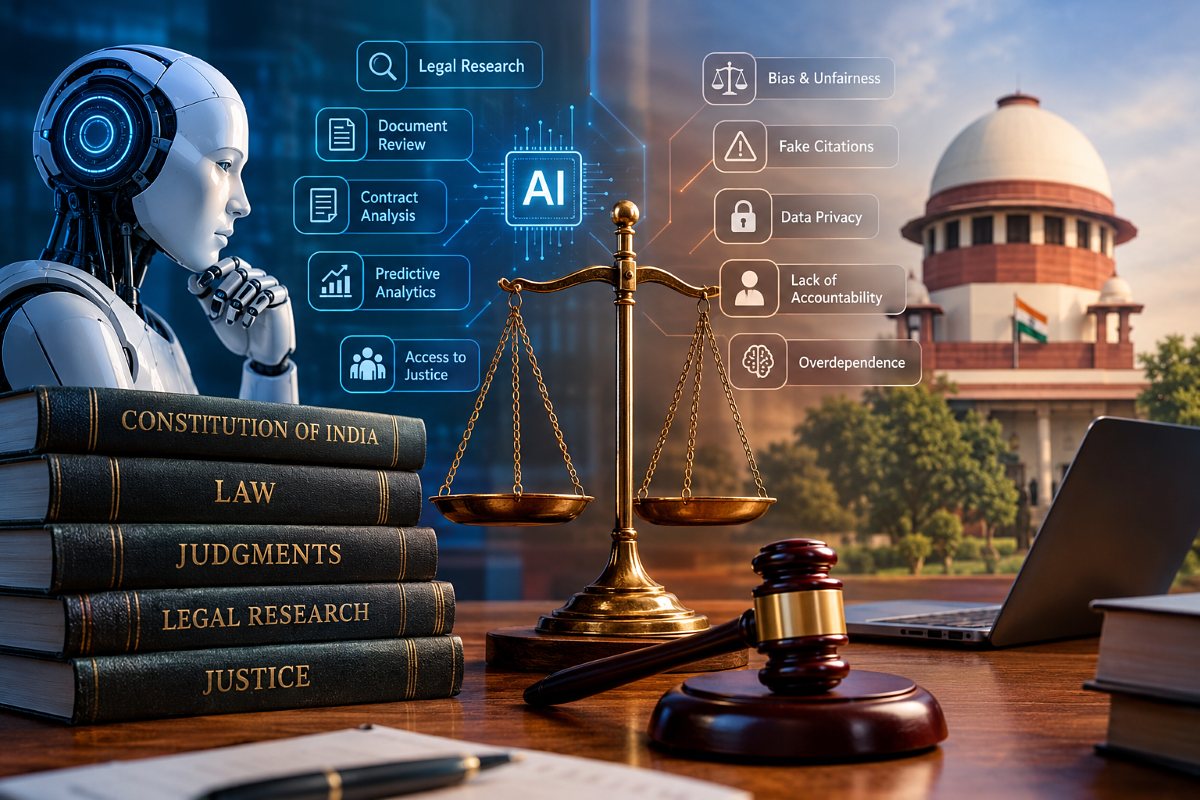
Can a machine deliver justice, or can it only calculate an outcome? Can artificial intelligence make India's legal system faster, fairer and more accessible, or will it introduce new forms of bias, error and injustice? And when technology influences a decision that changes a human life, who should bear the responsibility?
These questions lie at the heart of one of the most significant debates facing the modern legal system. AI is transforming legal research, document drafting, contract analysis and case management. For India, where courts carry heavy caseloads and many citizens struggle to obtain affordable legal help, it offers a real opportunity to improve efficiency and widen access to legal services.
The promise, however, comes with considerable risk. The law is not merely a collection of statutes, precedents and procedural rules. It is a system founded on constitutional values, fairness, accountability and the protection of human rights. A machine may analyse thousands of judgments in seconds, but can it appreciate the circumstances of an accused person, the hardship of a litigant, or what it means to deprive someone of liberty?
The real question, therefore, is not whether AI belongs in the legal system, but how it should be used, regulated and held accountable.
The growing role of AI in legal work
Driven by the need for efficiency, accuracy and lower costs, lawyers, researchers, law firms and courts are increasingly turning to AI tools for work that has traditionally taken considerable time and effort: legal research, contract review, document automation, due diligence, case summaries and the identification of relevant precedents.
In India, these capabilities could prove particularly valuable. AI may help lawyers navigate an ever-growing body of legislation and case law, help litigants understand procedure, and support courts in managing administrative workloads.
Efficiency should not be confused with correctness. An answer generated in seconds is not necessarily accurate, and a convincing argument is not necessarily a sustainable one.
The challenge is to ensure that technology strengthens legal reasoning rather than replaces it.
The Indian judiciary: towards a regulated framework
Recognising both the opportunities and the risks, the Supreme Court of India has begun building a framework for the responsible use of AI in courts.
In June 2026, the Supreme Court released the draft Regulations for Use of Artificial Intelligence (AI) in Courts, 2026 for public consultation. Prepared under the aegis of the Court's Artificial Intelligence Committee, the draft is built around human primacy, transparency, accountability, data protection and judicial independence. It keeps AI in an assistive role and bars it from determining judicial outcomes.
One of its most important features concerns AI-generated material in proceedings. Under the draft, lawyers and parties who use AI to prepare pleadings, documents or evidence would have to disclose that use, and courts could ask which tools were used, how extensively, and what steps were taken to verify accuracy. Responsibility for any error would remain with the person who files the material.
The principle is sound: AI must not become a means of concealing the origin, reliability or preparation of material placed before a court. The consultation closed in July 2026. At the time of writing, the final regulations have not been notified, and their text may change.
High Courts have moved as well. The Kerala High Court's July 2025 policy for its district judiciary prohibits the use of AI for legal reasoning or decision-making. The Gujarat High Court's April 2026 policy, which covers both the High Court and its district courts, bars AI from judicial reasoning, the drafting of orders and judgments, and the evaluation of evidence.
The Supreme Court has also confronted fabricated citations directly. On 2 July 2026, in Pooja Ramesh Singh v. Jammu and Kashmir Bank Ltd., it set aside orders of the National Company Law Tribunal and the National Company Law Appellate Tribunal that had relied on non-existent, AI-generated judgments, and asked the Bar Council of India to constitute a committee, lay down guiding principles and specify the disciplinary consequences of such lapses.
These developments show the legal system confronting a fundamental point: AI cannot operate in judicial processes without safeguards. Formal rules alone, however, are not enough. Regulation must also set clear standards for verification, accountability, confidentiality and the limits of AI-assisted decision-making.
The benefits: a more efficient legal system
Faster, more comprehensive legal research
One of AI's greatest strengths is its ability to process enormous volumes of legal material quickly. Lawyers work daily with legislation, precedents, commentaries, procedural rules and case records, and finding the most relevant authorities can be slow and demanding. AI research tools can identify potentially relevant judgments, summarise principles, compare decisions and organise material around a legal issue.
For lawyers handling many matters at once, this can shorten preliminary research and leave more time for analysing facts, developing arguments and preparing for court. But AI-generated research must always be independently verified: its value lies not in the speed of the response, but in the accuracy and relevance of what it finds.
Contract review and document automation
Using natural language processing, AI systems can review lengthy contracts, agreements and pleadings, identify clauses, flag inconsistent provisions, extract key information and highlight language that needs closer scrutiny. This can support due diligence, regulatory compliance and contract management, and can help smaller firms and individual practitioners manage workloads that would otherwise demand substantial time and resources.
Yet a clause flagged by software still requires legal interpretation. The final assessment must account for the applicable law, the facts, the parties' intentions and the consequences of the terms.
Predictive analytics and litigation strategy
AI can analyse historical data to identify patterns in judicial decisions, litigation trends and outcomes, helping lawyers assess risk, consider settlement and plan strategy. But historical patterns cannot guarantee future results. Every decision turns on its own facts, evidence, law and arguments, and on the independent assessment of the court. Predictions should be treated as analytical aids, never as forecasts of how a court will rule.
Improving access to justice
Perhaps AI's greatest promise lies in making legal information more accessible. Many people struggle to understand legal terminology, identify the right remedy or navigate procedure. AI tools can explain legal concepts in plain language, assist with preliminary paperwork and describe the procedures available, and multilingual tools can help those who cannot easily access legal information in English.
Developed responsibly, such tools could narrow the gap between those who can afford extensive legal advice and those who cannot obtain even basic guidance. But access to information is not the same as access to justice, which also requires effective remedies, competent representation where needed, fair procedure and independent courts.
The risks: when technology becomes a source of injustice
Hallucinations and fabricated case law
One of the most serious risks is "hallucination": an AI system generating information that sounds convincing but is false. In legal research, this can mean non-existent judgments, invented citations, misquoted passages, or principles that the cited authorities do not support. The danger is acute because AI-generated legal language can sound authoritative even when it is wrong.
The problem is no longer hypothetical. In Mata v. Avianca, Inc. (2023), a United States federal court sanctioned lawyers who had filed a brief citing cases invented by an AI chatbot, and in India the Supreme Court has now set aside tribunal orders that relied on non-existent judgments. Where precedent is central to legal argument, the consequences are serious: fabricated authorities can damage a lawyer's credibility, waste judicial time, prejudice a client and attract professional consequences.
Every AI-generated citation must be checked against the original judgment or a reliable law report before it is relied on. AI may help a lawyer find a judgment; it cannot replace the duty to read, understand and accurately apply it.
The erosion of independent legal reasoning
A further concern is over-reliance. Legal practice demands far more than locating authorities and producing documents: a lawyer must identify the facts that matter, distinguish precedents, anticipate opposing arguments, interpret statutes and respond to the unexpected in court. These abilities are built through sustained reading, research, drafting and experience.
If students and young lawyers rely on AI to frame every argument and answer every question, they may never fully develop these skills. A lawyer who can produce a polished AI-assisted argument but cannot explain its legal foundation will struggle the moment a judge asks a question. Technology should support the development of a legal mind, not substitute for one.
Confidentiality and data protection
Lawyers handle sensitive information every day: personal data, commercial secrets, privileged communications and confidential case records. Entering such information into an AI platform without understanding how it handles data can create serious confidentiality and privacy risks. Where is the information stored? Who can access it? How long is it kept? Can it be used to train future models?
Lawyers must therefore take care before uploading client documents or confidential court material to any AI system. Responsible adoption requires secure systems, appropriate safeguards and clear rules on the use of sensitive information, consistent with a lawyer's professional duty of confidentiality and the Digital Personal Data Protection Act, 2023.
Accountability: who is responsible when AI gets it wrong?
The use of AI raises a difficult question: who bears responsibility when a system produces an incorrect or harmful result? The developer who built it, the organisation that deployed it, the professional who relied on it, or several of them together? The answer will depend on the circumstances, the applicable law and the nature of the error.
In legal practice, one principle must remain clear: using AI does not relieve a lawyer of the duty to exercise professional judgment and to verify the work submitted for a client. An incorrect citation cannot be excused on the ground that a tool produced it. Likewise, any use of AI in judicial work must preserve judicial independence, with responsibility for every decision resting with the judge. Clear accountability standards are essential to public confidence in the justice system.
Private AI providers and the challenge of judicial regulation
The expansion of AI in the judiciary also raises regulatory and commercial questions for technology companies. The draft regulations contemplate private providers supporting permitted AI applications in court processes, but on strict conditions.
First, a private vendor would need prior written approval from the appropriate authority before participating in any AI system deployed in court processes. Given the layered structure the draft proposes, including an apex AI body and AI committees in the High Courts, this could mean engaging with more than one authority, with attendant delay, compliance cost and uncertainty about the technical standards to be met.
Second, the draft addresses intellectual property. Where a tool is developed using court data or resources, the court would retain ownership of it or a perpetual, royalty-free licence, and private entities could not claim exclusive rights over tools built primarily on judicial data or public resources. For businesses built on proprietary products, these conditions will weigh heavily.
The concerns behind these safeguards are understandable. Judicial data is not an ordinary commercial resource: its use raises questions of confidentiality, public interest, institutional control and the ownership of technology built with public resources. The challenge is one of balance. A framework that is too restrictive may deter investment; one that is too permissive may expose sensitive data or allow private interests to override public ones.
Its success will depend as much on clear, consistent and efficient implementation as on the safeguards themselves. AI should not add another layer of red tape to a system already burdened by procedural delay. Regulation should instead offer a predictable, transparent and practical route to responsible innovation.
Should AI be banned in law schools?
The debate extends to legal education. Law students must learn to read judgments, interpret statutes, build arguments, draft pleadings and think independently, and excessive reliance on AI can undermine these foundations when it is used to avoid learning rather than to enhance it. Yet banning AI outright may leave graduates unprepared for a profession in which these tools are becoming routine.
Chief Justice of India Surya Kant addressed this at the second Vice-Chancellors' Conclave hosted by National Law University, Jodhpur, in August 2026. He advised law schools against prohibiting AI tools and called instead for their supervised, transparent and ethical use, with students taught to question and verify what these tools produce.
The argument is compelling. Law schools can build AI into research exercises, drafting assignments and case analysis while requiring students to find the original authorities, explain their reasoning and disclose the assistance they received. A student may use AI to locate potentially relevant judgments, but should still read them, identify the ratio decidendi, distinguish binding from persuasive authority, and develop the argument independently.
The future of legal education is not a choice between human intelligence and artificial intelligence. It is an education that teaches students to use both responsibly.
The way forward: an assistant, not a substitute
The task for India's legal system is to harness the benefits of AI without compromising the principles on which justice depends. Six priorities stand out:
- Verification: AI-generated research should always be checked against authentic judgments, legislation and reliable legal databases.
- Training: lawyers and judges should understand AI's limitations, particularly its tendency to fabricate citations, misread legal principles and present uncertain information with unwarranted confidence.
- Standards: clear rules should govern confidentiality, data protection, transparency and accountability.
- Fairness: AI systems used in judicial processes should be tested for reliability and bias, and must never deny parties a fair opportunity to challenge material that affects their case.
- Proportionate regulation: requirements should be clear and proportionate, encouraging responsible innovation while protecting litigants, courts and the public.
- Education: legal education must continue to prize independent reasoning, critical reading, ethics and practical advocacy, with AI complementing these skills rather than displacing them.
Above all, technological efficiency is valuable only when it serves the ends of justice.
Conclusion: can artificial intelligence understand justice?
AI presents the Indian legal system with both an extraordinary opportunity and a serious responsibility. It can reduce the time spent on repetitive tasks, support research, improve document management and make legal information more accessible, freeing lawyers and courts to focus on the questions that matter most.
Its limitations, however, cannot be ignored. Fabricated citations, algorithmic bias, confidentiality risks, over-dependence and uncertain accountability show that technological sophistication does not guarantee legal accuracy or fairness. The law deals with human lives, rights, freedoms and relationships, and applying it demands not only information and analysis but reasoned judgment, ethical awareness and respect for constitutional principles.
AI may identify a precedent, summarise a statute or suggest an argument. But every suggestion must withstand the scrutiny of legal reasoning, and every decision affecting rights must remain subject to the safeguards of law. The aim is neither to resist technological progress nor to embrace it uncritically, but to ensure that innovation strengthens the administration of justice.
The transformation of the legal profession is already under way. The real question is whether we will use AI to make justice more accessible, fair and accountable, or allow the pursuit of efficiency to overshadow the human values that justice exists to protect.
Sources
- Supreme Court of India, draft Regulations for Use of Artificial Intelligence (AI) in Courts, 2026, released for public consultation by notice dated 3 June 2026.
- Pooja Ramesh Singh v. Jammu and Kashmir Bank Ltd., Supreme Court of India, 2 July 2026.
- High Court of Kerala, Policy Regarding Use of Artificial Intelligence Tools in District Judiciary, July 2025.
- High Court of Gujarat, Policy on Use of Artificial Intelligence in Judicial and Court Administration, April 2026.
- Address of the Chief Justice of India at the second Vice-Chancellors' Conclave, National Law University, Jodhpur, 16 August 2026 (as reported).
- Mata v. Avianca, Inc., No. 1:22-cv-01461 (S.D.N.Y. 22 June 2023).
The law and policy described here are stated as of October 2026.Download this article (PDF)
